
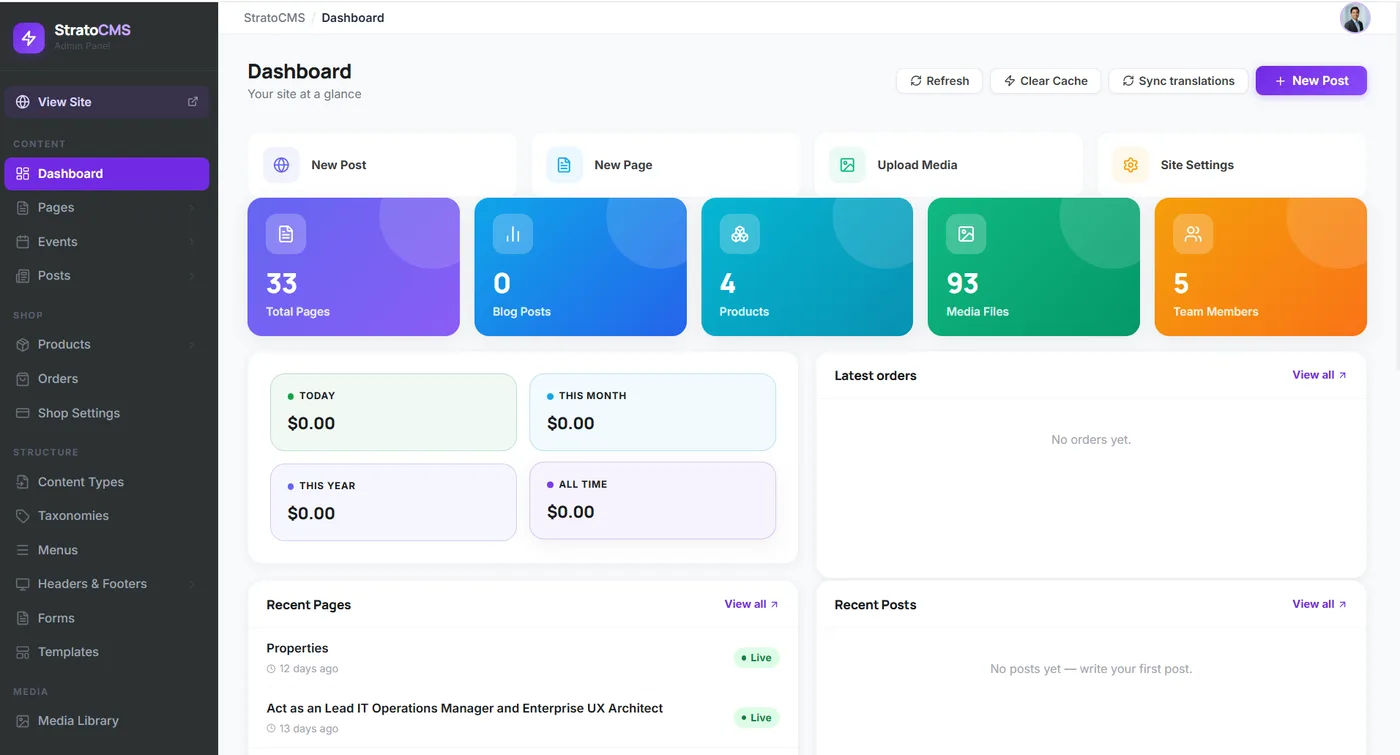
What StratoCMS is
A traditional CMS ties your content to one website's templates. That works until you need the same content on a mobile app, a partner portal, a digital display or a second brand site — at which point you are copying and pasting, and the copies immediately start to diverge.
StratoCMS separates the two. Content is modelled and edited in one place, and delivered as structured data over an API to whatever needs it. The website is one consumer of that content, not the container for it.
Who it suits
- Marketing teams publishing to a website and an app from one source.
- Businesses running several brand or regional sites that share content.
- Product teams that want a modern front end — Next.js, Nuxt, React Native — with a real editorial back end behind it.
- Organisations whose current CMS has become slow, fragile or expensive to change.
Content modelling
You define content types that match your business, not generic pages and posts. A property listing, a course, a case study, a product spec — each with its own fields, validation and relationships. Editors then fill in meaningful fields instead of formatting HTML, which is what keeps a site consistent two years after launch.
- Custom content types with typed fields — text, rich text, number, date, media, reference, repeatable groups.
- Relationships between types, so an author, a category or a location is linked rather than retyped.
- Reusable components for sections that appear across many pages.
- Validation rules, so a required field cannot be left empty and a URL has to be a URL.
Editorial workflow
- Draft, review and publish states with role-based permissions.
- Scheduled publishing and unpublishing for campaigns.
- Full version history with the ability to compare and roll back.
- Live preview of unpublished changes, exactly as they will appear on the front end.
- An audit trail showing who changed what and when.
Delivery and performance
- REST and GraphQL APIs, so front ends fetch precisely the fields they need.
- Responsive image handling with automatic resizing and modern formats.
- CDN-friendly caching with cache invalidation triggered by publishing.
- Webhooks to rebuild a static site or clear a cache the moment content changes.
- SEO fields on every entry — title, description, canonical, social image, structured data — plus sitemap generation.
Multi-site and multi-language
Several sites can share one content pool while keeping their own navigation, branding and overrides. Translations are handled per field with a clear view of what is translated, what is stale and what is missing, so a second language stops being a parallel website nobody maintains.
Security and operations
Role-based access down to content type level, API tokens scoped to what each client actually needs, rate limiting on public endpoints, encrypted transport, and audit logging. Self-hosted on your infrastructure or managed by us, with backups and a tested restore either way.
Where StratoCMS came from
StratoCMS grew out of WPStrato, an open-source headless CMS our team built and released as an experiment - WordPress for editing, React for the frontend. WPStrato proved the model and showed us exactly where a headless layer bolted onto someone else's CMS runs out of road. StratoCMS is the product built from those lessons: its own content modelling, its own API, and no dependency on WordPress. WPStrato stays in our portfolio as the prototype it was; StratoCMS is the platform we build on now.
What you get
- A content model designed around your business, documented.
- An editorial interface your marketing team can use without training wheels.
- REST and GraphQL endpoints with generated documentation.
- Front-end integration for your website, app or both.
- Migration from your existing CMS, with redirects mapped.
The moment content has to appear in a second place, the question stops being which CMS and starts being whether content and presentation were ever separated.