
What Expencio is for
Shared money is where friendships get awkward. Someone pays for the hotel, someone else covers dinner and the cab, a third person buys groceries for the flat, and a week later nobody can reconstruct who owes what. The usual outcome is that the person who paid most quietly absorbs the difference.
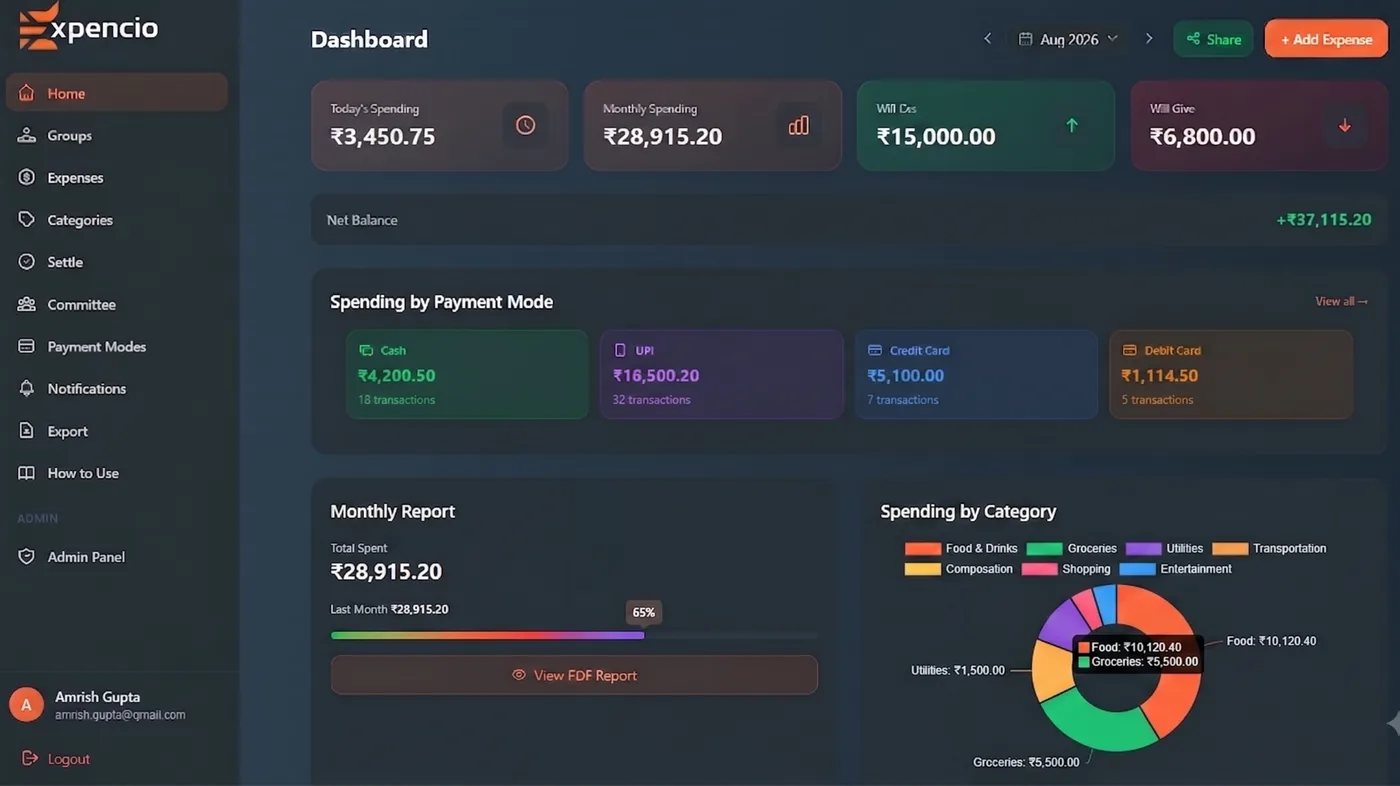
Expencio keeps the record so nobody has to. It handles your own spending and shared spending in one place, and it is opinionated about the thing that matters most: settling up in as few payments as possible.
Tracking your own spending
- Add an expense in a few taps, with category, date, note and payment method.
- Attach a receipt photo, so the proof lives with the entry rather than in your camera roll.
- Recurring entries for rent, subscriptions and EMIs, added automatically each cycle.
- Monthly budgets per category, with a warning as you approach the limit rather than a report after you passed it.
- Multi-currency with stored conversion rates, so a trip abroad still reconciles correctly months later.
- Charts showing where the money actually went, by category and over time.
Groups and splitting
Create a group for a trip, a flat, a household, a team lunch or an event, add the people involved, and log expenses against it as they happen.
- Equal split — the default, divided evenly across everyone in the group.
- Exact amounts — when three people shared a table and one only had a coffee.
- Percentage split — for rent where rooms differ in size.
- Split by shares — two shares for a couple, one for a single occupant.
- Partial participation — exclude anyone who was not part of a particular expense, rather than splitting it and correcting later.
- Anyone can pay, and anyone can log — the payer is recorded separately from who owes.
Settle up in the fewest payments
This is where most shared-expense tracking falls down. In a group of six, a naive tally produces a dozen small transfers going in circles. Expencio simplifies the debt graph and tells you the minimum set of payments that clears everything — often three transfers instead of twelve.
Balances are shown per person and per group, with a full history of what settled when, so a settled trip stays settled and does not get reopened by memory.
The community layer
- A shared activity feed per group, so everyone sees new expenses as they are added rather than being surprised at the end.
- Comments on individual expenses, which is where "what was this ₹4,000 for?" gets answered once instead of in five separate chats.
- Reminders that nudge politely, so nobody has to be the person who chases.
- Group invitations by link, with no requirement for everyone to sign up before an expense can be recorded against them.
- Recurring groups for households that keep running month after month, with a monthly close.
Reports and export
Per-group and per-person statements, monthly summaries, and export to Excel or PDF — useful for a shared household, for reimbursing a client trip, or simply for keeping a record once the group disbands.
Privacy and data
Your financial history is sensitive, and it is treated that way: encrypted in transit and at rest, no selling of data, no advertising profile, group members see only the groups they belong to, and you can export or delete everything you have entered.
What you get
- Personal and shared expense tracking in one app.
- Four splitting methods plus partial participation.
- Minimum-transaction settle up.
- Group feed, comments and reminders.
- Budgets, recurring entries, multi-currency and exports.
Tracking a shared expense is easy. Working out the three payments that clear a group of six is the part worth automating.