
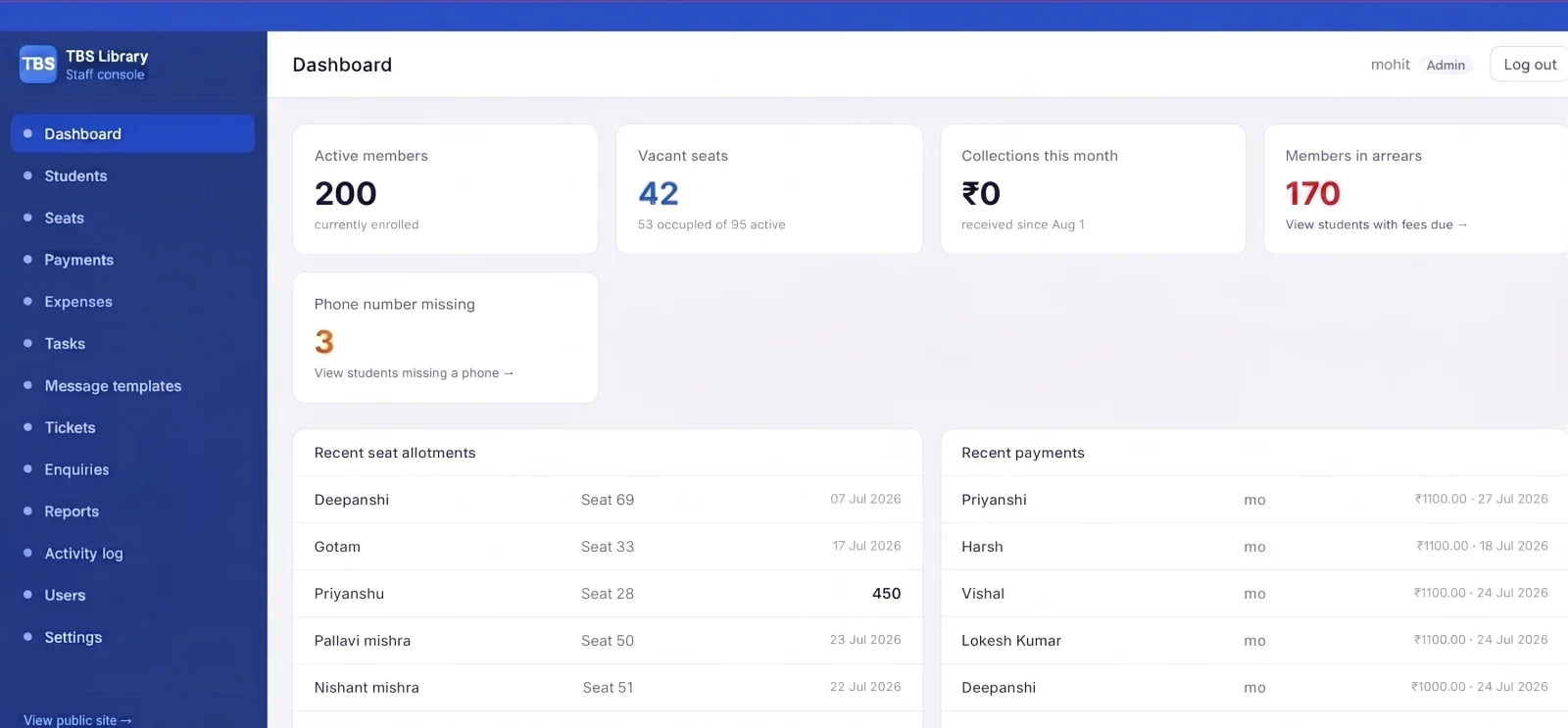
What it does
Libraries run on a handful of daily transactions — issue, return, renew, reserve, fine — and on knowing exactly what is on the shelf. Most of the pain in a library comes from those being tracked in a register or a spreadsheet, where a missing book is only discovered at annual stock verification and a member's history exists only in someone's memory.
This system handles the whole cycle, from accessioning a new title to the report the management committee asks for at the end of the year.
Catalogue
- Accession register with unique accession numbers generated automatically.
- ISBN lookup that pulls title, author, publisher and edition, so cataloguing a new book takes seconds rather than minutes of typing.
- Barcode and QR labels generated and printed from the system, and scanned at the counter.
- Classification support for Dewey Decimal and your own local scheme.
- Multiple copies of a title tracked individually, each with its own condition and location.
- Books, journals, periodicals, e-resources, CDs and thesis copies all handled as distinct material types.
- Multi-branch and multi-department support, with transfers between locations recorded.
Members
- Member categories — student, faculty, staff, external — each with its own borrowing limits, loan periods and fine rates.
- Bulk import of students from an existing register or ERP at the start of a session.
- Membership validity tied to the academic year, with expiry and renewal handled in bulk.
- Photo ID cards with barcodes, printed from the system.
- Full borrowing history per member, plus outstanding dues at a glance.
Circulation
- Issue and return by barcode scan, with limits and eligibility enforced automatically.
- Due dates calculated from the member category, with holidays excluded.
- Renewals, with a cap and a block when the title is reserved by someone else.
- Reservations and hold queues, with the next member notified automatically when a copy comes back.
- Fines calculated automatically per day overdue, with configurable rates, caps, waivers and a record of who authorised each waiver.
- Lost and damaged handling, including replacement cost recovery.
- Offline-tolerant counter mode, so issuing does not stop when the network does.
Search catalogue for members
A public OPAC where members search by title, author, subject, ISBN or keyword, see live availability, reserve a copy, check their own borrowed items and due dates, and renew where the rules allow it. That alone removes a large share of counter queries.
Notifications
Automated email and SMS for due-date reminders before the fine starts, overdue notices, reservation availability and membership expiry. Reminders sent before a fine accrues are the single change that most improves return rates.
Reports and stock verification
- Circulation statistics by day, category, department and title.
- Most and least issued titles, to inform what to buy and what to withdraw.
- Overdue and outstanding fine registers.
- Accession register and withdrawal register in the formats auditors expect.
- Stock verification by barcode scanning, producing a missing-items list in hours instead of closing the library for a week.
- Exports to Excel and PDF for committee and accreditation reporting.
What you get
- Migration of your existing catalogue and member records.
- Barcode label and ID card printing configured to your stationery.
- Staff training at the counter, where it matters.
- Role-based access for librarian, assistant and administrator.
- Backups, and support through your first stock verification.
A library does not need more software. It needs the issue counter to take five seconds and stock verification to take an afternoon.